Inglewood Community Coalition
Our city. Our vote.

Inglewood
Belongs to
Inglewood.

We are residents, parents, faith leaders, small business owners, teachers, and Block Captains organizing for a city government that answers to the people who live here, not the consultants and donors who profit from us.

For Inglewood, by Inglewood

A community source of truth.

The deals, the dollars, the decisions that shape every block of Inglewood, sourced from public records, laid out in plain sight, verifiable by you.

Don't take our word for it. Read the receipts.

Our Mission
Revitalization without displacement.

A coalition for the
city we all live in.

Inglewood is in the middle of an unprecedented building boom, but the receipts of who's actually benefiting tell a different story than the press releases.

The Alliance for a Better Inglewood is a community-led coalition fighting to ensure that Inglewood's renaissance benefits the people who built this city, not just the well-connected.

We believe revitalization can, and must, happen responsibly. That means transparent contracting, accountable government, and development that lifts up longtime residents instead of pushing them out.

We are neighbors organizing for the city we want to live in, the city we want our children to inherit, and the city our parents and grandparents fought to build.

New Campaign
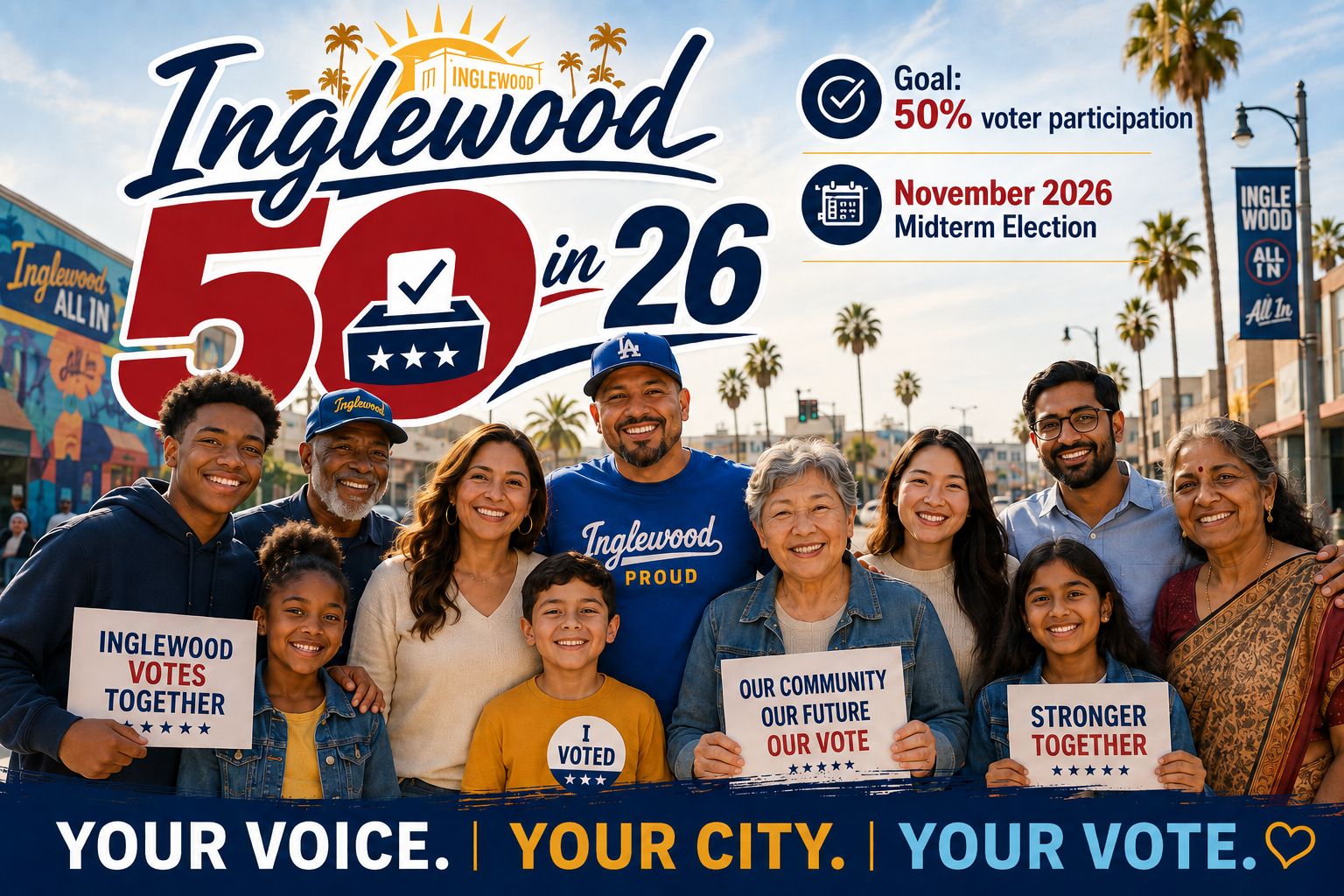
Inglewood 50 in 26 — a diverse group of Inglewood residents and families in downtown Inglewood holding signs reading Inglewood Votes Together, Our Community Our Future Our Vote, and Stronger Together. Goal: 50% voter participation, November 2026 midterm election. Your Voice. Your City. Your Vote.
Voter Participation Campaign
Your voice. Your city. Your vote.

Inglewood 50 in 26 is a community-powered campaign working to achieve at least 50% voter participation in the November 2026 midterm and Inglewood mayoral election.

Your voice matters. Your vote has power.

Inglewood's future should reflect the participation of its people.

78.1%
of registered voters turned out in the 2008 presidential election — a level not reached since.
37.6%
turnout in 2022, the last time Inglewood elected its mayor.
≈1 in 5
registered Inglewood voters cast a ballot for the winning mayoral candidate.
50%
our shared goal for November 2026.
50 IN 26

In the 2008 presidential election, 78.1% of Inglewood's registered voters participated. Turnout has not reached that level since. In 2022, when Inglewood last elected its mayor, voter turnout was only 37.6%. Yet decisions made at City Hall directly affect our neighborhoods, public safety, housing, development, transportation, and essential city services.

The votes received by the winning mayoral candidate represented approximately one in five registered Inglewood voters.

For context: the candidate received 53.7% of the votes cast in the mayoral race, and votes equal to 50.7% of all ballots cast citywide — because so few residents voted, a majority of a small turnout still meant only a fraction of Inglewood was heard.

Nonpartisan by design

This campaign is not about telling anyone who to support. It is about encouraging every eligible voter to participate, consider the facts, and make an informed choice.

Together, we can ensure that more of Inglewood is heard — and reach 50 in 26.

What We're Fighting For
The receipts are in the public record.

Four fights.
One Inglewood.

From a 40-year billboard giveaway in our public streets to eminent-domain seizures along Market Street, the same pattern repeats: insiders win, longtime residents and small businesses lose. We're organizing around four fights that will define Inglewood for the next generation.

01

Transparent Government

End insider contracting. Demand competitive bidding, public hearings, and independent forensic audits of every major city deal, including the WOW Media billboard agreement, the Inglewood Transit Connector, and the Destination Market Street grant program.

02

Protect Public Spaces

Keep our medians, sidewalks, and right-of-way in public hands, not leased to private advertisers for forty years. Stop the silent commercialization of the streets our families walk every day.

03

Real Community Benefits

Negotiate genuine community benefits agreements that put residents first when stadiums, transit projects, and developments come to town. Billions in stadium revenue and billboard money should reach the neighborhoods that absorb the noise, traffic, and displacement.

04

Accountable Leadership

Hold elected officials accountable to the people who put them in office, not the consultants and donors who profit from their decisions. Our ballot is the most powerful check on City Hall, and we intend to use it.

Inglewood by the Numbers
Who actually lives here.

100,488 reasons
to get this right.

The people behind the numbers, and a city government that should answer to them.

100,488
Total Population
2026 estimate
11,083
Per Square Mile
density across 9.07 mi²
$72,750
Median Household Income
14.64% poverty rate
−6.4%
Population Change
since 2020: 6,890 fewer residents

Population Trend, 2015 → 2026

115k 110k 105k 100k 95k 111.4k 110.4k 108.4k 105.3k 103.4k 101.7k 100.5k 2015 2017 2019 2021 2023 2025 2026 A peak of 111,439 in 2015, falling every year since.

Race & Ethnicity

Black or African American
39.1%
Other race
29.9%
Two or more races
17.7%
White
9.4%
Asian
2.6%
Native American
1.2%
Native Hawaiian / Pacific Islander
0.1%

Median age 38.6 · Adults 84,325 · Seniors 15,113 · 92 males per 100 females

Home Values: Inglewood vs. Los Angeles County

Zillow Home Value Index (ZHVI): the standard residential index used by federal economic data services and major housing analysts.

Inglewood
$725,552
▼ 2.0% year-over-year
As of April 2026
Los Angeles County
$888,345
▼ 0.6% year-over-year
As of March 2026
−$162,793 gap Inglewood values sit ~18% below the LA County median, and are falling more than 3× faster than the county as a whole.

The increased home-value statements being published don't match the record.

Small Businesses Lost: Downtown Inglewood, 2021–2026

Two longtime Black-owned anchors gone in the last 18 months. Eight more properties under active eminent domain. The City's own 2022 environmental review put the displacement list at 41 businesses, and the number has only grown.

41
Businesses on the ITC displacement list
City's own 2022 Final EIR
8
Properties under active eminent domain
City Council vote, Feb 10, 2026
~50%
Market Street storefront vacancy
LAist, March 2026
Closed Lost in the last five years
  • Stuff I Eat
    114 N. Market St. · Vegan soul food · Black-owned
    Closed April 26, 2026 after 18 years. Founded by Chef Babette Davis. Reported by The LA Local.
  • Sip & Sonder
    108 S. Market St. · Coffee house · Black women-owned
    Closed December 31, 2024 after 7 years at the flagship. Co-founder Amanda-Jane Thomas cited "hurried gentrification … that ultimately led to disgruntlement and displacement." Reported by the Los Angeles Times and LAist.
Under Threat Active eminent domain
  • Fiesta Martin Bar & Grill
    Market & Florence shopping center
  • Luxe Gold Salon
    Market & Florence shopping center
  • DD's Discounts
    Market & Florence shopping center
  • CVS at Inglewood Plaza
    The city's only 24-hour pharmacy

All authorized for forced sale by an Inglewood City Council vote on Feb. 10, 2026 (unanimous, 4–0).

Sources: Los Angeles Times · LAist · The LA Local · Knock-LA · 2 Urban Girls · ITC 2022 Final EIR · Inglewood City Council records, Feb 10, 2026. Verify everything yourself.

Income, by Household Type U.S. Census ACS

Median is the midpoint: half of households earn more, half earn less; it's the best read of a typical Inglewood household. Mean is the arithmetic average, pulled higher by top earners. The gap between the two columns is a quick read on income inequality inside each household type.

Household type Median incomemidpoint · typical household Mean incomeaverage · pulled up by top earners
Married Families$99,311$123,244
Families$82,201$103,525
All Households$72,750$93,554
Non-Family Households$49,466$67,666

Sources: World Population Review, drawn from U.S. Census Bureau Population Estimates and the American Community Survey. Last updated June 2026. Verify everything yourself.

Inglewood's Schools
What the reports found.

Nearly half
the district,
closed.

Since 2012, the Inglewood Unified School District has been governed not by its elected school board but by state and county appointees. Thirteen years and nine administrators later, twelve of the district's twenty-five schools have closed and enrollment has fallen by nearly 40%. Two reports published in the past year, one by a community coalition and one by the state, examine where the district stands. The Alliance is posting both in full below.

How we handle documents we didn't write

This section holds material the Alliance did not write: research by community organizations, reports from state agencies, and other perspectives that belong in front of Inglewood residents. We did not produce, fund, or edit these documents, and we do not necessarily adopt their conclusions. Our standard still applies here, to the sourcing rather than to the claims. For anything posted in this section we name the author and the date, we link the complete original so you can read it yourself, and we report figures as the authors reported them. Where a figure can be checked against the primary record, we check it. The findings and the recommendations belong to their authors, and what to make of them is your call.

48%
Of IUSD schools closed
12 of 25 campuses since 2018
−39%
Enrollment, 2015–2025
Black student enrollment down 45%
43%
Chronically absent, 2023–24
Highest in LA County · ~$15–20M/yr lost
14 yrs
Under state receivership
Since 2012 · nine administrators
Student Outcomes: IUSD vs. County & State 2023–24 · CDE / CA School Dashboard
MetricIUSDLA CountyCalifornia
Chronic absenteeism43%21.7%20.6%
Math proficiency16%25%36%
English / ELA proficiency29%53%47%
Graduation rate81%89%87%
Class size (per teacher)32.824.823.7
College preparedness14.5%38%45%

IUSD's figures are worse than both the county and state averages on all six measures. For chronic absenteeism and class size, lower is better; for the other four, higher is better. Figures as compiled in the IUSD Report Card from CDE and CA School Dashboard data.

The two reports

The IUSD Report Card

Community assessment · Stop IUSD School Closures Coalition & ACLU SoCal · Authored by Dr. Amir Whitaker · Published 2025

A participatory-research report built from public data, surveys, focus groups, and media coverage, assessing the district across 13 years of state and county oversight. Among the findings it reports:

  • Twelve of the district's 25 schools have closed since 2018, which the report describes as creating "school deserts"
  • A teacher-to-student ratio of 33 to 1, against a county average of 25 to 1
  • The lowest average teacher salaries in Los Angeles County
  • Chronic absenteeism the report estimates costs the district $15 to $20 million a year in funding
  • Thirty separate issues, policies, and failures the report links to the closures, many of them documented in state reports
@stopiusdschoolclosures on Instagram →

The July 2026 FCMAT Report

State progress report · Fiscal Crisis & Management Assistance Team · July 2026

FCMAT scores the district against statutory recovery standards. Its July 2026 report records:

  • Financial Management at 6.37 out of 10 and Facilities Management at 7.26, the highest in the six years of scores the report tabulates, with no standard in either area below 4 for the first time
  • The elected board still serving in an advisory role, with no date set for restoring its authority, and a trustee keeping stay-and-rescind power even after that happens
  • Projected unrestricted deficit spending of $13.3M in 2025-26, $21.2M in 2026-27, and $26.4M in 2027-28, which the report describes as unsustainable
  • District enrollment down about 12,007 students, or 66.8%, from its 2003-04 high of 17,969
  • A $55M emergency loan authorized in 2012, of which the district drew $29M, carrying $1.83M in annual debt service with the final payment due November 2034. The report notes the district now holds reserves sufficient to pay the balance off early

The two enrollment figures on this page measure different things. The Report Card's 39% decline covers total enrollment, including charter school students, between 2015 and 2025. FCMAT's 66.8% decline counts students in district-run schools since 2003-04. Both are as their authors reported them.

Where the reports agree

The plain-language explainer linked below, also written by the coalition, sets out where the two documents overlap. Although prepared for different purposes, it says, both identify the same themes: the district has made measurable operational improvements, enrollment continues to decline, long-term fiscal stability remains a significant challenge, continued improvement is needed before IUSD can fully exit receivership, and student outcomes and community confidence remain important concerns.

What the Report Card recommends

The Report Card closes with recommendations and demands addressed to IUSD, LACOE, FCMAT, and state policymakers. Among them:

  • Halt further closures and reopen shuttered campuses with a real plan
  • Return local control to an elected board on a dated, public roadmap
  • Retire or forgive the remaining state loan so dollars reach classrooms, not debt service
  • Invest in full-service community schools with wraparound supports
  • Raise teacher pay to compete with neighboring districts
  • Restore reliable student transportation and honest, early community engagement

These are the report authors' recommendations, summarized here, not the Alliance's platform. The full list is in the report itself.

In the community's words

The Report Card draws on focus groups and surveys with families across the district. One parent, quoted in the report, described what the closure of a neighborhood school meant to their daughter:

"It felt like they erased part of our history."Inglewood Unified parent, quoted in the IUSD Report Card (2025)

Read the documents

Sources: California Department of Education & CA School Dashboard (2023–24) · FCMAT July 2026 Progress Report · IUSD Report Card (2025). Figures as reported in those documents. Verify everything yourself.

Our 2026 Agenda
Sign. Vote. Build.

Where we
stand.

Three citizen initiatives to make Inglewood government more open, more transparent, and more answerable to residents. Each one needs your signature to qualify for the ballot, then your YES vote in November. Tap any measure to read what it does and the proponent's case.

Led by HEIRS PAC

These initiatives are spearheaded by HEIRS PAC, the Helping Empowered Individuals Reach Success Political Action Committee. HEIRS PAC works to strengthen police accountability, government transparency, and public trust through policy advocacy, candidate endorsements, and community organizing. In Inglewood, it is advancing all three ballot measures (the Bryan Bostic Act, the Police Commission Amendment, and the Fair Governance & Term Limits Act) and mobilizing residents and organizations to endorse, volunteer, and help qualify them for the November 2026 ballot.

See the initiatives & sign on at HEIRS PAC →
On the ballot · sign & vote
Ballot Initiative

Inglewood Fair Governance & Term Limits Act

Reasonable term limits for Inglewood's elected officials, so no seat becomes a lifetime appointment.

Petition · help qualify for the Nov 2026 ballot

The Act would set reasonable limits on how long a person can hold elected office in Inglewood. Term limits are one of the most widely used safeguards in American government: they apply to the President, the Governor, the state legislature, and neighboring cities like Los Angeles. Inglewood is currently one of the few major cities in the region with no limits at all. The measure keeps power close to residents by ensuring regular leadership transitions and opening the door to new voices.

What it does

  • Establishes term limits for Inglewood's elected offices
  • Prevents the concentration of power over extended periods
  • Encourages fresh leadership and broader civic participation
  • Strengthens public confidence through predictable transitions

Proponent's Statement

I support the Inglewood Fair Governance & Term Limits Act because a healthy democracy depends on the regular renewal of its leadership. This measure would establish reasonable term limits for Inglewood's elected officials, a common-sense safeguard that keeps political power close to the people it is meant to serve.

Term limits are not a radical idea. From the presidency to the state legislature to the City of Los Angeles next door, America limits how long its leaders can hold power, because no single officeholder, however capable, should hold power indefinitely. Yet Inglewood remains one of the few major cities in our region still without them.

As our city enters an era of unprecedented growth and investment, the stakes of that gap have never been higher. This measure is not about any one person. It is about protecting the democratic process itself: ensuring accountability, expanding opportunity, and guaranteeing that every generation of Inglewood leaders earns their place. Sign the petition, and vote YES this November.

Steven FisherProponent · Alliance for a Better Inglewood

Ballot Initiative

Bryan Bostic Police Transparency & Accountability Act

Body cameras, fast footage release, and independent audits: one of the strongest transparency policies in Southern California.

Petition · help qualify for the Nov 2026 ballot

Named for Bryan Bostic, who died in Inglewood police custody in March 2026, when the city had no body cameras and released almost no information for weeks, this measure builds transparency directly into policing. It is written to protect residents and the officers who serve honorably, by letting the record speak for itself.

What it requires

  • Body-worn cameras active during all law enforcement encounters
  • Public release of footage within 15 days of a critical incident
  • Enforceable accountability standards when footage is missing
  • Annual independent audits of police practices

Why the rules matter: the City approved a $6.3M body-camera purchase in June 2026, but hardware alone doesn't guarantee release timelines, audits, or consequences when footage goes missing. This measure sets those standards in writing.

Voices for the Bryan Bostic Act

“It is not anti-police. It is pro-community, pro-accountability, and pro-trust.”

Yolanda Davidson · Inglewood resident & proponent

“Bryan should still be here today.”

Davanna · aunt of Bryan Bostic

“It’s time to reel them in, hold them accountable.”

Charles Braggs · former Inglewood commissioner

“You cannot expand surveillance without expanding accountability.”

Dallas Fowler · HEIRS PAC founder

“Long overdue.”

Jonathan Moseley · National Action Network
Ballot Initiative · Charter Amendment

Inglewood Police Commission Authority & Accountability Amendment

Revives an independent civilian police commission with real oversight power and district-based representation.

Petition · help qualify for the Nov 2026 ballot

This Charter Amendment revives Inglewood's civilian police oversight, dormant for years, as an independent Police Commission with genuine authority. Where body cameras capture a single encounter, a standing commission holds someone accountable for the patterns and policies behind them, year after year.

What it establishes

  • An independent civilian Police Commission with real oversight authority
  • District-based community representation: every part of the city at the table
  • Regular public reporting from the Police Chief on department operations
  • Ongoing oversight of use-of-force incidents and transparency compliance

From the sponsor · HEIRS PAC

HEIRS PAC, with the National Action Network, filed this Charter Amendment to establish independent civilian oversight of the Inglewood Police Department: a five-member commission empowered to appoint, evaluate, and remove the police chief and to review use-of-force incidents and misconduct.

Founder Dallas Fowler framed it as part of a larger promise: that Inglewood families should not be met with silence after a critical incident, and that a city preparing to host the World Cup and the 2028 Olympics must hold its public-safety institutions to the same rising standard. “Transparency is non-negotiable.”

Dallas FowlerFounder, HEIRS PAC

Our Campaigns
One fight at a time.

Where we're
focusing our energy.

Each campaign is a coordinated effort: research, public records requests, council comment, community education, and direct action. Here's where we're putting the work right now: the documents, the stakes, and how you can help.

Current Campaign

Don't Believe the Propaganda

Accountability and transparency aren't slogans; they're the least a city owes the people who pay for it. What Inglewood residents have met instead is contempt: public-records requests slow-walked or ignored, debate cut short, and major decisions defended with press releases instead of answers. So we follow the money and put the documents in front of you (the legal bills, the hiring, the contracts) because a government confident in its choices doesn't need to hide them. The most powerful answer to being talked down to is to show up. Read the record, trust what you see, and let your voice be heard at the polls in November.

StatusActive
ForNov. 2026 Election
Follow the Money flyer Download the flyer (PDF)
Current Campaign

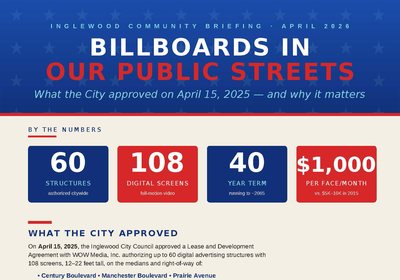
Billboards in Our Public Streets

In June 2026, a Los Angeles judge let the City's 40-year deal with WOW Media stand, and the stadiums that sued have said they'll appeal. But for the people who live here, this was never the billionaires' fight. Whatever the venues' contracts say, the real questions are simpler: Who agreed to turn our public medians into four decades of digital advertising? Who decided our shared streets could be commodified into blight, and when were the residents who live alongside them ever asked? A courtroom won't settle that; the ballot will. This campaign stands on a principle that shouldn't be controversial: the people of Inglewood have a right to a seat at the table for every decision made in their name. Our streets are not for lease.

StatusActive
ForNov. 2026 Election
Billboards in Our Public Streets briefing Download the flyer (PDF)
Community ideas · in engagement
Community Engagement Stage

Circle Park Fountain Revival

Restoring the park's long-dormant fountain as a community art project: tiles made by residents, families, youth, and local artists.

Early concept · gauging community interest

At the center of Circle Park sits a fountain that hasn't run in over a decade. Its tilework still has real character, but the structure shows wear and would need plumbing and repair before it could flow again. The idea is to restore it not just as a working fountain, but as a community art project, where residents, families, youth, and local artists help create and decorate the tiles used in its resurfacing. Instead of simply repairing something broken, the park would be renewed by the very people who use and love it.

What we're exploring

  • Whether there's enough community interest and support to pursue it
  • Working with local artists and arts organizations on design and hands-on tile workshops
  • Youth and family participation rooted in Inglewood's own identity
  • City coordination on permissions, plumbing, materials, cost, and long-term stewardship

This is an early concept, not a committed project. We're sharing the premise first to see whether residents would want to help make it real. Tell us what you think.

Connect
Find us where you already are.

Follow the
movement.

We post council meeting recaps, action alerts, public-records receipts, and reminders for every public hearing that matters. Pick the platform you actually use, and we'll meet you there.

Live Updates
Straight from the field.

What we're
posting now.

Council meeting recaps, action alerts, and on-the-ground photos from the campaign, straight from our Instagram feed.

Follow on Instagram
@allianceforabetteringlewood

Posts load directly from Instagram. If the feed doesn't appear, follow @allianceforabetteringlewood directly.

Get Involved
Add your voice.

Stand with
your neighbors.

Inglewood doesn't change because anyone is waiting around for it. Pick the action that fits your week, and we'll meet you there.

  1. 1 Vote in November. Your ballot is the most powerful check on City Hall. Research every candidate.
  2. 2 Show up. The Inglewood City Council meets Tuesdays. Public comment is your right. Use it.
  3. 3 Tell a neighbor. Block by block is how this gets done.
Our sister site

Meet the neighborhoods
behind the movement.

The Real Inglewood celebrates the blocks, districts, and gated communities that make our city home: many front doors, one name. Where the Alliance fights for accountable government, The Real Inglewood tells the story of the people we're fighting for.

Visit The Real Inglewood →